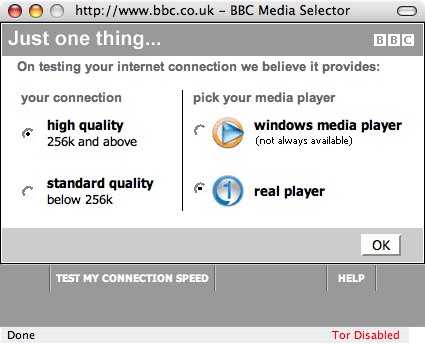
The BBC is using Real Video and Windows Media on its web site, which means that you either have to have Real Player (I wouldn't touch anything by Real after downloading a version of their player years ago which was basically adware) or Windows Media Player installed.
I don't think they got the memo:
It's the end of 2006 and the online video format wars are over. Flash won. Please use Flash video on your web site to provide a hassle-free viewing experience to the widest possible audience.
The BBC doesn’t get web video article by Aral Balkan, unless otherwise expressly stated, is licensed under a Creative Commons Attribution-Noncommercial 2.0 UK: England License.
Wouldn’t that be a nice Christmas present! Unfortunately a beast as big as the Beeb moves slowly. They’ve probably invested a lot in the infrastructure to handle Real and Media player. I hope someone there sees the light. How about if they also added an API like flicker to query their video content!
a while back the bbc were making their own open source codec..
i’m not quite sure whether that is still happening though
Is Brighton an hour ahead of London? post made at 22.16
Paddy: If you were at Flash on the Beach, you’d know that Brighton is a different planet, complete with its own weather system consisting of horizontal rain and mad drunk geeks challenging the wind to a fight.
Aral: Sorry I missed you there. I got to see your talk, but never got to hook up with you and Niqui. Give me a call if ever you’re in London and want to get together – Niqui has my number.
Considering they use a fair amount of flash around the rest of their site it is a shame they don’t use flash video.
They have a massive investment deal with Real, that’s why they’re still using it. But they are experimenting with Flash video… http://www.bbc.co.uk/bbctwo/
Hi Aral… I know that some sites do not like the download-and-play Flash and video, and don’t want to commit to streaming servers, because then the content can be copied and used by others.
… I was just hunting for an article I remember, an interview with a BBC media-division exec, who explained that — because the BBC extracts money from UK taxpayers — it cannot provide content to people in other regions. I also remember a time-dependency in this interview, where they’d want to make something free to UK viewers for a week or two, before turning it into archive material, which would help get the bills paid.
Rightly or wrongly, some content-providers don’t wish their digital bits to be copied. Real and WMP have an advantage in this area. I suspect that’s what’s driving the UI hassle you’re dealing with. :(
jd
yay for diversity.. there were many video formats for the technically insuperior flv and I hope there will be many after.. I agree.. flv provides the best user experience and has the biggest install base, so it’s also what I would recommend right now for clients.
However, I think its great big players who have enough ‘power’ to make people download alternative plugin just to watch their content.
Perhaps at one point there will be a great open format player, so there won’t be any vendor-lock-in. (so you won’t have to sell your soul to a single corporation)
At the bbc.backstage conference a year or two back, someone from the BBC mentioned that they have to be careful with the codecs they use due to licence fees as well as restrictions as a result of third party patents – this was their main reason for not going with any of the open source codecs, and what was powering the drive for their Dirac codec [ http://en.wikipedia.org/wiki/Dirac_(codec) ].
Also, the BBC can’t carry advertising as part of its remit, so they have a special “ad free” variant of the Real Player – I think its the one you can download from here: [ http://www.bbc.co.uk/radio/audiohelp_install.shtml ]
The BBC is definitely experimenting with Flash video. Check out these animations about children in poverty which aired on BBC One’s Newsround (my area) and are now available on-demand in Flash. http://news.bbc.co.uk/cbbcnews/hi/newsid_6080000/newsid_6087600/6087626.stm. The viewing stats for them are very impressive. But there are rights and other issues that still need to be worked through. There are lots of people at the BBC who are looking at moving forward on this in 2007.
@John, what do you mean by ‘and don’t want to commit to streaming servers, because then the content can be copied and used by others.’
Maybe you meant *can’t* be copied and used by others. They are using streaming right now and while the fact that streams can’t easily be saved is a bit of a myth I would presume that the BBC simply cannot afford to use Flash if they want to stick with streaming. Like it or not, Flash Video is still prohibitively expensive when streamed, and that’s almost entirely the fault of Flash Media Server’s pricing structure…
yup, bad phrasing on my part… they want offline use, for instance, and so don’t want streaming… but then they’re vulnerable to FLV copying, because the file itself isn’t encrypted. Right now the only way FLV protects against repurposing is with a live server connection, which doesn’t fit with other needs for some content providers.
jd
Flash will be an okay way of doing video on demand when Gnash, the GNU project’s Flash player, can play those videos in a Free Software webbrowser.
Even then, Ogg/Theora video would be the best format, because it is Free Software – which means it is ethical and unsustainable. Please see the GNU website for details – http://www.gnu.org/philosophy/
John Dowell writes, “Some content-providers don’t wish their digital bits to be copied.” But you can’t make a digital bit that isn’t copyable. At its very core, copying bits is what a computer does, and the core concept of a computer network is copying bits between computers. It simply can’t be done, and there will always be pages like http://www.fravia.com/destream.htm no matter what draconian laws are passed to try and prohibit it. We need to be honest about these things, instead of trying to close our eyes to thse basic truths, or we’ll end up in an awful society that prohibits sharing and sues grandmothers and little kids for doing what we teach is the right thing to do from a young age – share with friends.
“We need to be honest about these things, instead of trying to close our eyes to thse basic truths”
Hadn’t realized I was lying or deluded, or perhaps you were speaking of some “John Dowell” someplace instead…. ;-)
Yes bits can be copied but the functionality of viewing is not practically copyable if the bits’ meaning is encrypted. (And yes all encryption is crackable, but at what cost, even the PGP and personal encryption we celebrate…)
Gnash stuff is a nonstarter… if you read their lists, they’re talking about which other codecs they should use (that don’t match the world’s content), and whether FFMpeg might help them (Adobe staff contributed to FFMpeg and know it won’t)
ANYWAY, that’s one reason the BBC is using protected video formats… the quote’s somewhere out on the web, about their UK taxation and restriction problems.
I think the problem is that right now there’s no sign of the One True Video Format for ever and ever amen.
Right now Flash Video is easily the best, but who’s to say how long that will continue?
It’s really hard to commit to any one format right now as multimedia delivery is a fast-developing area.
For the sake of argument, lets say Flash Video’s Year Zero was 2004. In just 2 years it has made use of QuickTime, Windows Media and Real look and feel old like Black and White TV.
With an archive as big as the BBC’s it could easily take them 2 years to make their archive available as FLV’s. Then having committed to this, they bring their shiny new FLV archive into a world that’s moved on to whatever format is offering the best delivery.
No-one wants to get caught like that.
I believe they use Reals Helix Server to stream their content, which they have spent a lot of time and money on. Probably the reason why they are a bit reluctant to move to Flash.
“Hadn’t realized I was lying or deluded,”
Steady on, John :-)
I certainly didn’t mean to imply you were lying, and deluded is a strong term. I am saying that you seem confused about how computers work, and need to take an honest reappraisal of the facts :-)
“Yes bits can be copied but the functionality of viewing is not practically copyable if the bits’ meaning is encrypted.”
First, the bits’ meaning is not something that exists inside a computer.
It only exists in human minds and human laws. Inside a computer, bits have no meaning, its all just 1s and 0s. If it was possible to make some bits unlike other bits, we would have unexploitable computers that aren’t subject to code injection flaws.
So the idea the computer can do anything with the bits’ “meaning” is, well, meaningless :-)
Second, you say “encrypted.”
Encryption is about keeping secrets. It typically involves three parties: a sender, a receiver and an attacker/code breaker/cracker.
*Not* all encryption is crackable, because when the reciever and the cracker are different people, the attacker doesn’t have all the pieces of the puzzle. The PGP and personal encryption we celebrate is NOT crackable. If this is unfamiliar, please check out http://en.wikipedia.org/wiki/Public-key_cryptography :-)
But this kind of ‘encryption’ is a sham, becuase the cracker is *also the receiver*.
The sender *has* to provide the reciever-cracker with the keys to unencrypt the bits, for the
media to be playable.
Of course, asking “At what cost?” is sensible.
The cost of programming is a cheap computer to type on, and time. If you don’t yet know how to program, or even much math, that means *A LOT* of time. But if you do know, and you have experience of reverse engineering, it doesn’t mean that much time – so little you can do it in your spare time.
Of course, if you’re in a community of crackers racing each other to see who can do it first, you might put a lot of spare time in – but this only speeds the process.
For example:
Microsoft put millions upon millions into ’securing’ their Xbox console to stop people copying games. Console manufacturers sell console hardware at a loss, because they expect to recoup their losses on game sales.
The xbox was cracked, and many people use it as a dirt cheap computer to watch copies of films they’ve downloaded on their television.
Determined not to get hacked again, Microsoft spent more millions on securing the Xbox 360.
It took 4 months. (http://www.gamepro.com/news.cfm?article_id=52731)
Big Champagne, a company that monitors P2P networks, estimated the typical time it took music available with ‘anti copying’ measures as ‘exclusive’ to the iTunes Music Store to appear without the ‘anti copying’ stuff on P2P networks.
It takes less than three minutes. (http://www.craphound.com/hpdrm.txt & http://www.craphound.com/hpdrm.txt)
The more popular the format is, the more interest there is in having it cracked. And the more popular it is, the harder it is for the anti-copyers to change their system.
While you say that “Gnash stuff is a nonstarter,” that doesn’t match my expectations – the FLVs I download play fine on VLC, so I don’t think that it will be a problem. But I’ll raise your points on the Gnash mailing list, and get back here :-)
The BBCs other problem, trying to keep its bits within the UK’s physical borders, is also a bit dim. The Internet is a global network, now-here, no-where. If bits can be copied inside the UK, they will be copies outside the UK. Have BBC execs not seen http://www.uknova.com?
John, I just got a reponse back from the Gnash lead developer on the Gnash list: “We never talked about which codecs, we support Gstreamer and ffmpeg, so we support whatever codec those support, although right now the ffmpeg support works better. Most of the discussion was on which which library to use, so we decided to support several. I don’t think this blogger is really paying attention, and I’m not sure what the BBC uses.”
A further reponse on the Gnash mailing list: “[Playing video from sites like YouTube and Google is] being worked on on heavily right now, so it’ll more likely be in the next release sometime in the Spring. The Real protocol isn’t support that well by anything, including helix. Windows media has some support, it depends on the version. YouTube and Google use FLV, which is decently supported by ffmpeg and Gnash. So yes, the BBC would be better off using Flash than what they are now.”
JD says: “Gnash stuff is a nonstarter… if you read their lists, they’re talking about which other codecs they should use (that don’t match the world’s content), and whether FFMpeg might help them (Adobe staff contributed to FFMpeg and know it won’t)”
From this inaccurate smear, it sounds like Adobe are frightened… or peeved that the BBC won’t give over to them. Flash player is closed-source spyware; it sends your personal data to whoever the movie creator chooses roughly three times per movie on average. Too many sites cannot now be viewed with*out* installing adobe’s secret black box – a few weeks ago, TEDtalks for instance closed the door in the face of anyone without flash player and an “Adobe Experience” logo appeared at the foot of the page.
Adobe’s strategy is forced market dominance, closing off as much content as possible to anyone who does not want to run their software and this should be resisted in the interests of fair competition. That is the whole point of gnash, and the reason sites should not restrict their content to flash.
Gnash won’t bury Adobe, but we will give people a choice not to have to use x86 processors, not to have to use one of the big three OSs, not to be forced to install black-box spyware if they want to view some web content.
As for “video wars are over and flash won”… hahahahahahahaha That might be good as sales pitch from an Adobe employee but is simply untrue. Enforcing an unnecessary flash wrapper on existing video streaming formats is quite unnecessary. There are many video players to choose from, most of them better tham the flash wrapper, and it stops people from viewing the content whose net connection is not smooth and fast. The only people its use benefits is Adobe.
Not that I like the BBC’s current choices much – realplayer and Windows Media are not better from this point of view. The poor old taxpayers paid and pay for BBC content to be produced, and then BBC.com wants to sell it to them again on DVD or VHS. This may be why they are losing their royal charter, and rightly so.
M
Hi Martin,
Well, first off, I’m not an Adobe employee and secondly, I stand by my statement. I’m coming at this as a user not a developer. Thus, when I want to watch video on the web, I want to watch video on the web. Not wonder which codec (what’s a codec? why should I care?) I want: “Oh, look, it just works.”
Right now, Flash Video gives you the “just works” experience and, as a user, that’s what I care about.
I think the big point a lot of people are missing here is that the BBC’s job is to get the content to as many people as possible as cheaply as possible, not just to try out whichever cutting edge open source or free software is the darling project du jour.
Windows Media Player has a pervasive presence in the desktop market thanks to the stranglehold Microsoft has. The BBC has a large historic investment in RealPlayer streaming infrastructure which it would be pointless to write off. The Flash player is almost universally installed by mainstream web users.
All of those are compelling reasons for the BBC to continue with the formats it is using, and to experiment with Flash video without committing to another huge infrastructure spend.
Josephine Bloggs has never heard of Ogg or DIRAC, and doesn’t want to have to download new codecs just to watch BBC video. And just imagine the Daily Mail – “BBC wastes millions of Licence Fee money on video format that doesn’t come pre-installed on Windows PCs – 97% of high street PCs could not play BBC video clips straight out the box” :-)
Martin Belam, Regarding the BBC’s Real infrastructure investment, have you heard the phrase “good money after bad”? :-) Its a fallacy to keep spending money on something that is now a poor choice, because in the past it was a good one.
Aral, Free Software is for users more than developers :)
aral: I’m not an Adobe employee
I know you’re not, but John Dowdell, who made the comments I was objecting to, is, and so probably reflects the sort of things people say within Adobe (thanks for that, John!)
Unfortunately, my open-angle-bracket rant close-angle-bracket … open-angle-bracket slash rant close-angle-bracket got removed by the comment engine, so just imagine it’s there.
M
Before I crawl back under my bridge :) I can answer your (aral’s) specific points.
The BBC is publicly funded and by its charter is not allowed to broadcast advertising or even mention or show specific products in its programmes. By extension it should not be promoting, let alone forcing, the use of commercial products.
To reach the widest audience, you publish in publicly recognised formats that any media player will recognise. If there is no single format that most media players recognise, or if the only common-denominator formats are too crufty, like mjpeg or animated GIF, then you publish in several public formats.
Personally I publish in XviD-mpeg4 and (for poor old Windows Media users) mpeg1. MOV would be another widely-recognised candidate. Streaming is just a matter of the data transport mechanism, not the video format, and most video player programs support both. Check out the way archive.org supply their video content for a large public example (of not very good technical quality I may add).
The BBCs problem is that it got taken over by accountants in the 1970s, and has been run as a money-oriented business more and more ever since. Good work is also being done there, but largely despite “the system” rather than with its help. Flashing (no pun) its broadcast content at the public for a week instead of making a public archive of their stuff is a compromise to their profit motive, for fear that sales of BBC audio and video publications might fall off (it wouldn’t – see the way steadily-falling audio CD sales suddenly doubled in the year of Napster), and the use of real player and WMV streaming follows the same line: look-but-don’t-touch. Adding Adobe Flash to their list of container options would be completely in line with their current policy. I guess Adobe are just asking for too much money for them to do it, and anyway, that doesn’t let them reach any market that is not currently covered by the Real and Windows rubbish.
As for “widest public”, you are forgetting the immense world of non-x86 processors, and non-windows-or-mac operating systems, including all the cellphones and internet tablets of the world, which use ARM, Sparc, MIPS and other processors on which Flash does not run without Gnash. The hand-held internet market is about to explode, the way cellphones did a few years ago, and it doesn’t use Intel processors because their baroque architecture consumes too much battery life for too little performance.
Streaming with regular protocols in well-known public formats makes people’s content available to this vast arena too, without risking a repeat of the worldwide disater in desktop computing that Windows has caused.
Regarding reaching the widest possible audience, I don’t think we need to write pages upon pages when a single world will do: YouTube.
YouTube would not have been YouTube if it used Windows Media or Real (or even gave users a choice of every other available format out there.) YouTube became YouTube because it made it simple for people to access video on the web and today, that means using Flash video.
Agreed. My problem is when an essentially video site is Flash-only instead of Flash-also.
Easy on the “spyware” charges, Martin Guy. I know those ads are on the front FSF Gnash page, but that’s pretty incendiary stuff to say.
“How should an interface expose network requests, local storage requests?”… this would be a more useful way to look at the issue.
There’s also a vital need to distinguish between same-site traffic and traffic to different domains… a “show all requests” mode risks missing the signal for the noise. There are significant reasons why cross-domain policies have evolved.
“Adobe’s strategy is forced market dominance, closing off as much content as possible to anyone who does not want to run their software and this should be resisted in the interests of fair competition.” Charges like this also increase the distance between us.
jd/adobe
aral: ‘YouTube would not have been YouTube if it used Windows Media or Real (or even gave users a choice of every other available format out there.) YouTube became YouTube because it made it simple for people to access video on the web and today, that means using Flash video.’
That’s quite a claim to make, would you like to qualify that with some sort of proof? I believe you’re applying some very misguided logic to this argument: YouTube uses Flash, YouTube is popular, so Flash must be great! BBC doesn’t use Flash, so BBC must be bad!
Personally I am very happy that the BBC supports both Real and Windows Media formats, Real ‘just works’ perfectly for me. I might also remind you that Flash (if they chose to use the latest format) wouldn’t have ‘just worked’ for the all the Linux users out there. The latest Flash player for Linux is still in Beta and appeared months after Windows/Mac versions.
I’d also like to see you substantiate this ridiculous claim:
‘It’s the end of 2006 and the online video format wars are over. Flash won.’
John Dowell, yes, I think saying “Flash is spyware” is a bit harsh, because in itself it isn’t (as far as I know, past the usual update checks.) Your comment about increasing the distance sadden me, as I’m aware that Adobe have made several high-profile efforts of late to engage with the Free Software community, and explain their position. I saw this is a sign of change in the company. I aim to start a dialogue with my tone and subjects, and would be sad to see the walls go up again. I hope you’ll find time to comment on my posts here :-)
Liam, steady on :) I think that the idea Flash has won the online video format war is a bit strong, but its certainly gained a surprising lead on the incumbent players like Real, WMV and Quicktime. It has gained that lead because ‘it just works.’ And with the imminent support of Gnash, this is actually quite good for Free Software. ‘Ridiculous’ however is a strong word, and not friendly :-(
aral, though YouTube did make it easy to watch video on the web, its “secret sauce” was that it made it easy to UPLOAD video to the web. This is an important distinction that many of YouTubes competitors have not quite grasped, I think :-)
Martin Guy, your comment about “flash-also” is very good. What I just commented to Liam about Flash Video streaming being good for Free Software is of course not the best thing – the best thing is to encode the master video in as many formats as possible, including Ogg/Theora which is a free-software-friendly codec. For a very good example, http://www.redhat.com/promo/summit/videos/ is nice (and taking time to watch Eben Moglen’s short speech is highly recommended :-) When I start posting vidoes online, I will actually post lower quality copies in proprietary formats, and both lower and higher quality copies in Ogg/Theora, to call attention to its superior quality and freedom status :-)
Re: “Flash player is spyware” – I completely take that back and I apologise to Adobe. A reliable and well-informed source ran some flash movies with a netbox between the flash-playing computer and the internet, and logged an average of three blasts of personal data per movie, but I do not know whether these were initiated by the flash player program or by the movies it was playing. I guess you’d have to check where they were being sent. Either way, the effect is the same on J. Random User.
“Flash spyware”, as it was called on the GNU page, is a better term. Anyway, even if the spying is initiated by the movies, it is allowed by the player, in the same way that viral spam storms are enabled by Outlook Express, document viruses are enabled by Microsoft Word. Once someone distributes software worldwide with gaping security holes, it in inevitable that some people will exploit them. All the more reason to press for an alternative and open-source Flash player.
I think it is more that the BBC is reluctant to overhaul its video platform and implement flash video, due to the huge amount of work it must be.
However if they were to, I would have no doubt they would use flash video like youtube and all the other new sites that deliver video content over the web.
@ Martin -
“Flash spyware”, as it was called on the GNU page, is a better term.”
Spyware is still a pretty incendiary term … what facts do you have to back up that assertion?
I’m running FireFox 2.0 right now, free, open-source software, and I when I visit any number of sites, those HTML pages (an open standard) make any number of unprompted, silent, HTTP (another open standard) requests to 3rd party domains. Those requests send my IP, cookie, current URL and more. Would you consider Firefox to be spyware? If not, how is the security model in Flash worse/less secure?
How does Gnash plan to better address the issue of network connectivity? Under the Features section here [http://www.gnu.org/software/gnash/], the copy says “Gnash pays extra attention to all network connections, and allows the user to control access”, but gives no further information.
Thanks,
-steve / adobe systems
Martin, how is Flash in any way spyware? What are these “blasts of personal information” that your friend logged? Could they possibly have been domain-specific data being sent from the client to the server. If so, I do conceed that such blatant spyware like activity is being undertaken as we speak on nearly every web-site on the Internet today and perhaps we should take action against this crazy out-of-control spyware Internet. Just now, I believe that my blog transmitted my login information over the Internet to my server. I hear that some Ajax apps do this silently! Unbelievable!
I say we start with the spyware Ajax stuff and then lock down those browsers so they can’t transmit information over the Internet. That should make things secure for a while! :)
Seriously though, you shouldn’t be making baseless acusations (”spyware”) without proof. If you have some proof, please present it and I’ll be the first to support an open discussion about it.
Don’t forget the existence of Java Cortado Applet ( http://www.flumotion.net/cortado/ ) that could to be a fierce competitor for Flash.
Its advantages are :
1. 100% Free (Java, codec video Theora, codec audio Vorbis).
2. As simple as Flash for the user.
3. You can watch your video in full screen if the webmaster choose to put the link to the ogg video and watch it in the movie player of your choice.
4. The video have the quality of a ogg video traditional, not the bad quality of the flash video.
Some demo :
– http://stream.fluendo.com/demos.php
– http://www.ouvrirlesmedias.info/cortado/demo.html (in french but show the perfect integration of Cortado with Javascript).
[sarcasm]Wow, that rocks![/sarcasm] How large is the Java plug-in again? :)
Here’s a thought: If Java was “as simple as Flash for the user”, Java would be where Flash is today.
Also, Flash video now supports full-screen playback.
And, finally, can you please qualify “bad quality of the flash video”?
@steve: Regarding how Gnash allows the user to control network connections, Rob Savoye, the lead developer of Gnash, wrote in a mailing list post:
“Many of the Flash movies one downloads off the net have tracking in
them that records hits on a web site when that movie is played. I only
realized this when I first added working network support to Gnash. This
is trivially easy to do in a Flash movie in a way that you’d only notice
if you are running a packet sniffer. Many Flash movies also load part of
their content from other sites, so while this isn’t spyware directly in
this case, you are still making network accesses the user is 100%
unaware of.
“This is why I added support for whitelists and blacklists to Gnash, so
the users can control what goes on under the hood. If you dig around on
the net, you’ll see that many sites, like YouTube, set the Flash
“localdomain” to “*”, that basically says load anything you want from
anywhere… I prefer a finer level of control for Gnash users.”
BBC DRM…
BBC DRM: The taxpayer-funded British Broadcasting Corporation decides on a plan to offer general web access while still providing value to those who were forced to subscribe. Their goals include both time-constrained access to all subscribers, as well …
Aral, did you know that Real went so far as to produce a special ‘BBC’ version of Realplayer, it’s stripped of all the adware. It’s the only version of Real that I run. Search for it on bbc.co.uk/webwise.
Hi R,
Nope, didn’t know it — thanks for the heads up. Really worried that now the BBC is considering making their video Windows-only. I replied to their consultation questionnaire and hope that they reconsider.
http://news.bbc.co.uk/1/hi/technology/6625279.stm
[...] A while ago Aral posted on how the BBC didn’t get video on the web and at the time I agreed but understood that BBC isn’t a normal website, and changing over may not be that simple. [...]
Looks like they listened to you mate!
http://www.pixelbox.net/2007/06/08/bbc-trial-flash-for-video-content/